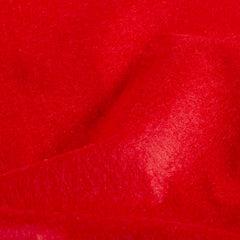
Felt

What is Felt Fabric?

Felt is a dense non-woven textile made by bonding fibres together rather than weaving or knitting yarns. Traditional felt is made from wool fibres that interlock through moisture, heat and friction, while modern felt can also be produced from synthetic fibres such as polyester. This construction gives Felt a compact, matte surface with good shape retention and little to no natural stretch. At Nooteboom Textiles, the current Felt qualities are polyester-based and are mainly used for decoration, accessories and creative applications.

Go to the Felt Collection

Specifications

  • Construction: non-woven textile made from consolidated fibres rather than woven or knitted yarns.
  • Composition: Felt can be made from wool or synthetic fibres; current Nooteboom Textiles qualities are 100% polyester (PL).
  • Weight: current Nooteboom examples include 170 g/m² and 470 g/m² for the 3 mm quality.
  • Stretchability: little to no stretch; the current Nooteboom Felt qualities are non-stretch.
  • Abbreviations: PL = polyester.

What Are the Properties of Felt?

Felt has no visible weave or knitted loop structure because the material is formed directly from fibres. Its dense construction creates a stable surface that can range from relatively flexible to firm depending on thickness and density. Polyester Felt generally has a uniform surface and consistent structure, while traditional wool Felt has a more natural fibre character. Felt can provide thermal insulation and some sound-dampening effect because air is held within the fibrous structure. Its stability also makes it suitable for shapes and components that need to retain their form.

How Does Felt Feel?

Felt generally feels soft to slightly firm with a dry, matte surface. Thinner qualities remain relatively flexible, while thicker Felt has more body and feels noticeably more rigid.

Applications

  • Accessories: suitable for cases, appliqués, decorative accessories and structured details.
  • Bags: thicker qualities can be used for bags, organisers and other items that benefit from shape retention.
  • Decoration: used for wall decoration, table décor, storage items and decorative panels.
  • Costumes and creative projects: suitable for masks, costume details, shapes and craft applications.
  • Technical and functional applications: depending on the specification, Felt can also be used for padding, insulation and sound-dampening components.

Wash Instructions

  • Washing temperature: polyester Felt may be washed on a gentle cycle up to 30°C when permitted by the care label.
  • Drying advice: dry flat or air-dry and avoid tumble drying at high temperatures.
  • Ironing instructions: if ironing is permitted, use a low temperature and preferably a pressing cloth.
  • Dry cleaning: only when allowed by the care instructions for the specific quality.
  • Special considerations: avoid wringing or twisting, as this can distort the shape and surface.

Other Information

  • Certifications: certification depends on the individual quality and should be checked at article level.
  • Cut edges: Felt does not normally fray when cut because it has no woven yarn structure.
  • Thickness: thicker qualities provide more rigidity and shape retention than thinner Felt.
  • Processing: the dense structure makes Felt suitable for cutting into defined shapes without requiring a traditional seam finish.

What Is the Difference Between Felt and Fleece?

Felt is a non-woven material with a dense, compact structure, while Fleece is generally a knitted fabric with a raised or brushed surface. Felt provides more shape and stability, whereas Fleece is softer, more flexible and more commonly used for warm clothing and blankets. Their surfaces can both feel soft, but their construction and behaviour during processing are very different.

Read more about the knitted alternative in our Fleece Fabric Guide.

What Is the Difference Between Wool Felt and Polyester Felt?

Wool Felt is made by encouraging wool fibres to interlock through moisture, heat and friction. Polyester Felt is made from synthetic fibres that are bonded into a non-woven sheet by an appropriate manufacturing process. Wool Felt has the natural characteristics of wool, while polyester Felt can be produced with a very consistent thickness, colour and surface. The correct choice depends on the required appearance, stiffness, care behaviour and intended application.

Practical Tip

When working with thicker Felt, test the needle, stitch length and seam construction on an offcut before production. Because the edges do not normally fray, some decorative components can also be used with clean-cut unfinished edges.

Do you have a specific question about Felt or an application?
Our AI assistant will help you immediately.

Added to cart

Welcome back

0
ART.NR.

You still have 0 articles in your cart